How to get your pay communications EU pay transparency ready
The results of my EU Pay Transparency Communications Readiness Assessment are in – and the average organisation is only 35% ready to communicate about pay transparency. (Median score 28.1)
Most companies I talk to haven’t started their pay transparency communications and they aren’t sure where they’re at or exactly how to start. So I built a diagnostic tool to help.
Now I’m sharing the anonymised results so you can see where others are up to, common gaps and the steps you can take to close them.
Organisations are all starting from different places
When it comes to EU pay transparency communications, every organisation is at a different point in the journey.
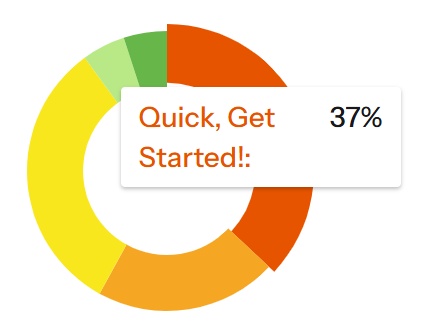
Some have taken the first steps to get their comms EU PTD ready, while others are well underway. And – surprisingly – more than a third of organisations have barely thought about it yet.
Most companies have lots to do
With an average readiness score of 35%, most organisations fall into the ‘Lots to do’ category.
Businesses in this group have taken the first steps towards greater pay transparency. Awareness is growing of the importance of fair pay and early communications are beginning to take shape.
Many basic components likely exist in draft or pilot, but are inconsistent, policy-heavy and not yet tailored to the EU PTD or to different audiences. They also probably sit in different places making it difficult for people to access what they need and understand the full story.
This places organisations at risk of:
uneven compliance across markets
inconsistent pay setting
a mixed employee experience
weak manager conversations
low employee trust
All of which has the potential to cause attraction, engagement and retention challenges.
To progress, organisations will need to:
Move from informal to intentional, robust communications that support equitable pay decision making, transparent pay conversations and compliant disclosures.
Create a strong narrative and key messaging to drive consistency
Ensure managers are informed and supported .
Sound familiar? Then read on for solutions.
Actions you can take immediately
Context and readiness
While the Directive is being transposed into local law, you can still:
Create a country legislation tracking matrix: thresholds, timelines, sanctions, and comms implications.
Align your pay philosophy with your EU PTD approach, including clear, gender-neutral criteria for pay and (if needed) career progression.
Create a 90-day communications plan that gets you from where you are to where you need to be for each country.
“Most reward leaders I talk to have decided to align with the Directive and adjust their approach and comms to meet local legislation as it’s published.” Becky Hewson-Haworth, Founder, Clarion Call Communications
Manager capability
Develop pre- and post-communication assessment tools to track reach and confidence signals across your key audiences (managers and employees).
Candidate and employee communications
Create your pre-employment pay disclosures and annual employee pay-information rights reminder materials.
Build toolkits and FAQs for managers, HR and recruitment teams to ensure legal compliance and alignment with your reward approach and to build capability and confidence.
Create high-level employee communications on your intranet sharing information in line with the degree of transparency you’re comfortable with - as well as meeting your legal obligations of course.
You could also position your communications as part of a journey towards greater pay transparency over time if this is your intention.
The average organisation is most unprepared in this key area
My survey data shows the typical respondent is only 29% ready to support managers by equipping them with the knowledge to hold effective, honest and clear pay transparency conversations with employees.
Creating toolkits, FAQs, scripts, one-pagers, plain-language policy documents and scenario support should be a key priority for organisations to ensure compliance and clarity.
Where organisations are excelling… and struggling
Looking at the scores for individual questions, organisations are excelling at having clear, documented, gender-neutral job evaluation criteria to inform communications and guidance. This is fantastic news because this forms the foundation for many pay transparency communications.
The three joint areas where organisations are struggling:
Ensuring employees can easily find the latest information about your approach to pay within three clicks from your intranet homepage
Preparing an annual notice communicating employees’ right to request relevant pay data
Tracking comms effectiveness - reach, comprehension, capability/confidence, employee understanding - and using the insights to update materials
How ready is your organisation?
To find out where your organisation sits on the readiness scale, take my EU Pay Transparency Communications Readiness Assessment now.
The diagnostic is split into four key areas - including context and readiness, candidate communications, employee support and employee capability.
Answer 20 questions like:
Do all EU job postings or pre-interview communications disclose the starting pay or pay range in clear, accessible language?
Are offer letters and pre-interview templates aligned with EU PTD range disclosure and country rules, with consistent plain-language phrasing?
Are there clear channels (e.g. a dedicated email address or Slack channel) to collect questions and sentiment about pay transparency and to iterate FAQs quickly?
And you’ll receive your score instantly. Explore your results to quickly see where you’re prepared and what’s missing. With a checklist of your key priorities in each area, you’ll gain the clarity that enables rapid and effective action.
Whatever your score, the diagnostic tool will help you identify your starting point and provide recommendations for what to do next in the four key areas.